My Parrot keeps BITING me! Please help!

We recently had a great discussion in the Parrot Chatter forum about the biting habits of Parrots. Feel free to click on the link below to view the forum thread and as always, if you’d like to join the discussion you can register here. Enjoy!

http://www.eclectusparrotbreeders.com/forum/viewtopic.php?f=4&t=183

What Spirulina and Bee Pollen can do for your Parrot

We recently had a great discussion in the Parrot Chatter forum about the health benefits of adding Spirulina and Bee Pollen to your Parrot’s diet. Feel free to click on the link below to view the forum thread and as always, if you’d like to join the discussion you can register here. Enjoy!

http://www.eclectusparrotbreeders.com/forum/viewtopic.php?f=69&t=173

Temperature tolerance for Eclectus Parrots

We recently had a great discussion in the Parrot Chatter forum about Temperature Tolerance for Eclectus Parrots. Feel free to click on the link below to view the forum thread and as always, if you’d like to join the discussion you can register here. Enjoy!

http://www.eclectusparrotbreeders.com/forum/viewtopic.php?f=69&t=121

Adding Bee Pollen to your Eclectus’ diet

We recently had a great discussion in the Parrot Chatter forum about adding Bee Pollen to your Eclectus Parrot’s diet. Feel free to click on the link below to view the forum thread and as always, if you’d like to join the discussion you can register here. Enjoy!

http://www.eclectusparrotbreeders.com/forum/viewtopic.php?f=69&t=110

Showering your Parrots

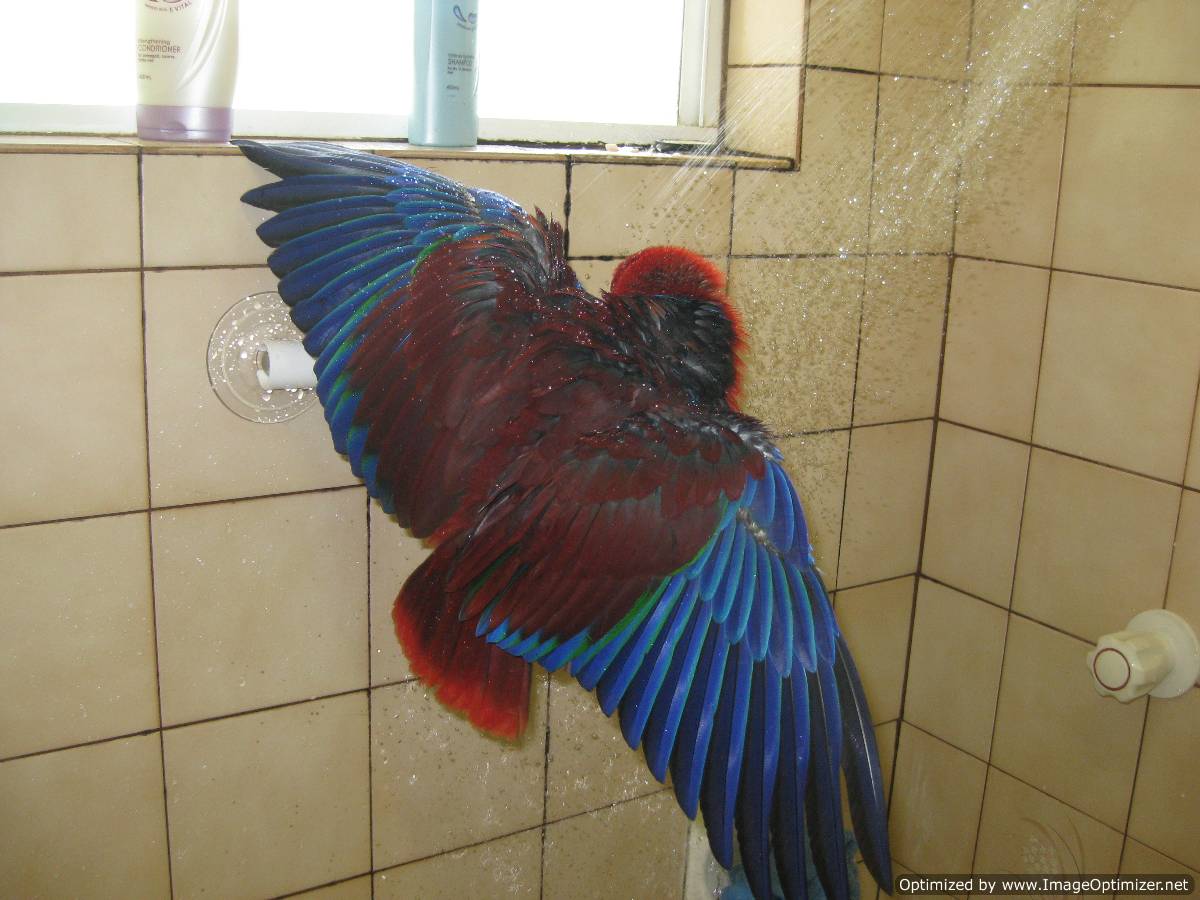
Showering has to be one of the most beneficial activities for our parrots (and its hilarious to watch), my own kids would literally spend all day playing under the warm water if I would let them. I love watching them flapping and singing away at the top of their lungs as they enjoy their daily shower !

Jez enjoying her daily shower

The Benefits of Showering your Parrot

Many species of parrots kept as pets originated from rainforest regions eg South America or in our Eccy’s cases PNG, Solomon Islands etc and their love of water and bathing seems almost innately part of their genetic makeup. Parrots are fastidious about their hygiene and cleanliness, not borne from vainness but out of necessity. If their plumage is not kept in top shape their feathers become tattered and broken and without the required preening they loose their ‘water proof’ coating that either comes from their oil gland or feather dust (eg cockatoos). In the wild this would be devastating for the parrot as it would impact their ability to fly there fore prevent them foraging properly to gain adequate sustenance and when wet, birds are unable to fly so it is instinctual for out kids to preen and bathe regularly.

Showering also helps your kids psychologically, its the same as you or I, you always feel better after a shower, smell a tonne better (well you’d hope so) and we enjoy taking the time to make ourselves look presentable afterwards . . our parrots are just the same 🙂

All of my own babies are bathed a minimum of 3 – 4 times a week from the age of one month onwards. I make bath time lots of fun, something to look forward to so when leaving Parrot Haven they already feel confident in having a shower and actually look forward to it . . . but what if your kids have not been raised this way?

First Timers

There is nothing worse than being forced into doing something we don’t want to do and our feathered kids are just the same so shower time must be introduced slowly and respectfully, putting yourself in your parrots position, understanding what they are trying to tell you via body language and letting them set the pace.

Some parrots love being misted down with a squirt bottle (sprayed gently and only on the mist setting) and this is a great way to introduce them to the concept of showering.  Start by having your parrot in an area they feel comfortable with and for many this is in their cage (but with the door open so they don’t feel trapped). Show them the water bottle so they don’t see it as scary and once they are comfortable with that gently mist next to their cage and gradually move your way in encouraging and making it sound extremely fun the whole time. If your parrot freaks out, stop immediately but if they seem interested then praise them repeatedly and they will soon learn that this ‘spray bottle thing’ is fun and will get to the stage they will puff up and get excited every time you bring it out.

Misting your parrot daily is a great habit to get into and your kids will absolutely love it !

Introducing them to the shower

My own kids actually join me in the shower and all of them absolutely love this with some even asking ‘I wanna come in for a shower’. Your parrot must trust you fully and you will need to have a very good relationship with them but again, it must not be rushed. If your parrot is included in the ‘every day activities’ of the home and is used to being out of their cage (which all parrots should) then its rather simple. Have the water already running then go and get your parrot and quietly bring them into the bathroom, praising them and encouraging them constantly. Don’t take them under the water as this will scare them, just place them up on top of the shower so that they can look down on you and see what this ‘showering’ thing is all about. Sometimes it will take weeks for them to gain their confidence, others will be fluffing up their feathers before you can even get under the water. Again let them set the pace and guide you and never push them out of their comfort zone.

Water Temperature

Nobody really likes cold showers, never an appealing thing (unless its stinking hot), I always shower my kids in nice warm water. Too hot will dry your kids skin out (same as it will for us) so keep it nice and warm.

Shower time !

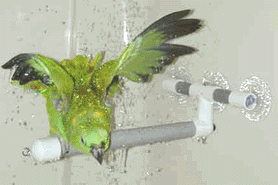
When your parrot feels confident enough to step up and join you in the shower you must again take it slowly. Some people like to use a showering perch others like to have their parrot perch on their arm but most importantly they will need to have a firm grip and feel comfortable that they will not slip at any stage. Gently sprinkle a little water over them by letting it spray off your body and see how they react. Take it slowly and again let them guide you. Many people are surprised as to just how quickly their kids take to showering and more often than not cant actually turn on the tap without having their feathered kids turn up ready for their fun.

Amazon using his shower perch

Feeling secure

Our parrots always like to be up high so don’t place the showering perch down too low. Some of my Eclectus actually love to play on the ground at my feet, splashing and rolling on their sides having an absolute blast . . but again, let them be the guide. Be aware of shower curtains blowing in as this may scare them and if your parrot is not keen on confined spaces try showing with the curtain/screen open – yeah, it will make a heck of a mess but its worth it in the end 🙂

Every parrot is different

Many of my clients will comment that their parrot will bathe differently to those of their siblings. Every one of my kids acts differently in the shower too. Usually when younger 3-6 months, my kids like to just snuggle up to mum and sit there enjoying the water and looking like drowned rats. Its usually not until after the 6 month mark that they really start to play silly buggers in there, wings out, flapping like crazy and chortling so loud you can barely hear yourself think. I also find that Eccy hens tend to be more vigourous shower’ers (based on the 23  mature Eccy’s I have) and the boys more so like to do the drowned rat thing playing and flapping a little less frequently than my hens.

Red for example talks up a storm and takes up the whole shower flapping and carrying on like a crazy thing. Sprout (her boyfriend) on the other hand is more subdued, just happy to let the water run over him watching Red with an expression as if to say ‘show some dignity girl’ 🙂

Stay away from soaps

Soaps and body washes are all well and good for us but should be kept well away when bathing your parrots. This will strip their feathers of their natural oils, very much a no no so avoid that at all costs.

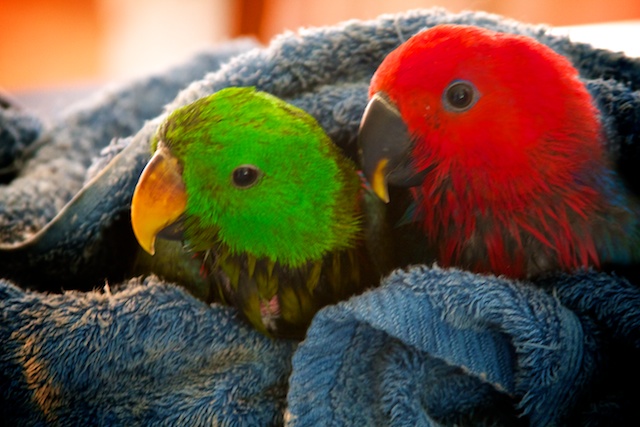
Billy and Holly - Two Parrot Haven babies snuggling up after their shower and ready for a blow dry (see http://eclectusparrotbreeders.com/forum/viewtopic.php?f=38&t=77)

Sunshine is a must

Just like us, our parrots need sunshine ! Showering in the cold winter months can be tricky and its often hard to simply put your kids outside in their outdoor cage to dry off. I live in an area where it can get rather cold during winter so my kids are always blow dried after their shower, they grow up with this as part of their routine and absolutely love it (see http://eclectusparrotbreeders.com/forum/viewtopic.php?f=38&t=77) but after their blow dry they are then placed in a nice warm area of the house next to a window where they can enjoy the sun.

During summer though we take full advantage of the sunlight. I personally don’t like to place my unweaned kids outside so I find a nice safe window (in a nice quiet position where people aren’t continually walking past outside) and place their cage next to the fly screen so they are getting both direct sunlight and have a shaded area they can move into if the are too hot.

If your bird is unable to be outside then filtered sunlight is a must. Try to allow them to sit next to the screen part of the window as opposed to the glass section, here they will still be getting the benefits required by sunlight:

– Aids in the synthesis of vitamin D3

– Assists in calcium absorption

– Helps with heavy moults aiding in feather development

– Assists digestion

– Plus the many  psychological  benefits of getting some nice sun

But again, make sure your bird is safe and secure and will not be frightened something moving past and consider the positioning of their cage as they must always have a ‘shaded’ are for them to move into if too hot as well.

So, if your bird is not a ‘shower-a-holic’ its time to introduce them to the joys of a daily bath, I guarantee you will have just as much fun watching them as they do playing in the water 🙂

Join Parrot Chatter – A new forum for parrot lovers

http://www.eclectusparrotbreeders.com/forum/

. . so why not check us out, yeah were all a little crazy but we all have a heck of a lot of fun !!

New Parrot Forum Launched

Welcome to Parrot Chatter
A forum for Avian Addicts everywhere !!!
http://www.eclectusparrotbreeders.com/forum/

Join in the insanity which is Parrot Chatter !!
http://eclectusparrotbreeders.com/forum/

Well we finally did it !! We now have a Parrot Forum !!

Were still fine tuning the look/colours/buttons etc etc and adding to my ever expanding crop of grey hair in the process, so if you see things changing you know were swearing copiously trying to make it all pretty like 😉

I would love our forum to be a place any parrot lover can go to chat with other like minded addicts, to freely ask questions and share stories of their feathered kids..

We have no stringent rules, love a wicked sense of humour and the funnier the photos the better! We ourselves have a rather warped sense of humour and cant wait to find others that are just as crazy as us!

We know our forum may take a little while to take off and we are asking all of our readers that if you like our forum to please recommend us to your friends, the more people the better (I got a little bored chatting to myself for the first few days)

So, please help spread the word, we need a really good Aussie Parrot Forum and with your help we can make it happen !!

Thanks guys,  look forward to chatting with you 🙂

http://eclectusparrotbreeders.com/forum/  (lol had to add it again) 😉

Treating and Recognising Concussion in Parrots

Emergency care

Parrots suffering head trauma or concussion

I received a phone call today from a very distraught owner who’s parrot had flown full tilt into a window.  The parrot was unresponsive, suffering wing droop, unable to perch and in severe shock, all signs of concussion or potential cerebral haemorrhaging. The obvious question asked was ‘What do I do now’? hence prompting me to write this article as bundling your parrot up in the car and taking them directly to the vet can actually be the worst thing you can do initially.

Unfortunately accidents like this happen all too often both in the home and in the aviary. Some species of birds can be easily spooked eg Neophemas, Finches etc especially when kept as aviary birds as sometimes all it takes is the flash of a set of headlights or the neighbourhood cat wandering past to spook the birds and send them into a state of panic with some parrots even known to have broken their necks due to night fright. Breeders with ‘night fright’ prone parrots are somewhat accustomed to discovering a ‘concussed’ parrot recovering in the bottom of their aviary on their morning rounds.

When it comes to companion parrots, windows are the bane of their existence, hence the reason I have the best excuse ever to only clean mine on the rare occasion. Regardless how ‘used to’ windows your parrot may be, all it takes is for them to take fright,  panic and fly head first into a window trying to escape the source of their fright.  Another common inflictor of  ‘head trauma’ is the humble ceiling fan, I have known many people who are beyond vigilant when it comes to turning off fans when their parrot is out but all it takes is for a friend or relative to come and visit, they may not be as vigilant and its the worst feeling in the world watching your beloved pet fly into a room only to realise the fan has been left on, hearing the dull thunk and hoping to heck that their necks aren’t broken.

Recognising the symptoms of concussion or cerebral damage

There are some very easy signs to look out for if you think your bird may be concussed. Sadly if there is brain damage there is not a great deal that can be done but both can present similarly. If you actually witness your bird fly smack bang into a window, its a pretty easy guess what has caused the problem but some owners will come home to find their bird perching but acting very strangely for no apparent reason. This is where this check list comes is to play.

Symptoms for medium grade concussion

1. Regurgitation

2. Difficulty perching

3. Slight wing droop

4. Aloofness

5. Loss of apetite

6. Uncoordinated flight

7. Needing to sleep a great deal more than usual (unusual sleep pattern)

8. Fluffed up and shivering coupled with above symptom(s)


Symptoms for serious concussion or cerebral haemorrhaging

1. Inability to perch, falling off perch

2. Ataxia – loss of coordination due to neurological damage

3. Head rolling onto back of neck, in circular motion or lolling entirely

4. Eyes rolling, tracking back and forth uncharachteristically

5. Convulsions

6. Unconscious entirely


So what do you do if this happens to your parrot?

1. First and foremost, you need to stay calm. If you panic you will be of no use to your bird, they need you to be level headed and will rely on you for both physical and emotional support.

2.  Gently pick your parrot up supporting their head, keeping it in a horizontal position. Do not let the head loll back, if there is neck trauma you will further this if not supported. Some parrots may bite out of pain if not severely concussed so may pay to grab something to use to protect your hands esp if the beak is a good size.

3. Never lay your parrot on their back to examine them for wounds. This is a sure fire way to kill a traumatised bird. By laying a bird on their back you are immediately dropping their blood pressure, many an avian life has been lost this way as its sadly not common knowledge.

4. Take your parrot to a quiet room away from kids, noise etc and gently and calmly examine them starting at their head. Work your way down the body very carefully checking wings, breast bone, legs etc. Don’t pull or poke, this is more a visual examination making sure their is no bleeding or bones protruding.

Bleeding:  If your parrot is bleeding badly, cornflour (or any flour) is a quick and easy ‘home remedy’ that has saved many birds lives. Simply place the bleeding limb or cover the area in cornflour (never the beak or respiratory areas) and this will act as a coagulant, allowing the blood to congeal and stop as birds can bleed out far too easily.

Fracture/Break: Your bird will need to see a vet as soon as they are stable but you do not want to rush them to a vet while they are still in shock, concussed and obviously in pain. Stop any bleeding, cover the wound (if bone is protruding) with sterile gauze (very gently) and work on stabilising your parrot. Do not try to put a joint back in as this can cause far more damage than good and further shock your parrot.

Stabilising Your Parrot

You need to stabilise your parrot before you even attempt to take them to an avian vet as some birds will sadly not survive the car trip if too badly concussed and in severe shock.

1. As strange as it sounds your voice will be one of the biggest things to help your parrot out of the very first initial stage of shock. Many a life has been saved by an owner simply talking to their beloved bird, their will to live is very strong and you need to give them a reason to fight.

2. You need to keep them warm, very important. If you can wrap them up in a nice warm towel. I have often placed a towel in the dryer for a minute to warm it slightly then wrapped it around an injured bird (very gently). This helps them maintain their body temperature and keep them stabilised. Once a birds core body temperature drops you have a hard time bringing it back up. Keep them warm but never let them over heat as this will also be detrimental. Warm but not hot. Use their feet as a gauge for their body temperature, cold toes means a cold bird.

3. Do not try to feed your parrot any form of food or water. If in shock their digestive system will have shut down and will need IV fluid to re start their system.

Depending on the level of trauma it may pay you to see if your avian vet will make a house call but as many don’t, please make sure your bird is stabilised before even attempting to take them in the car. Notify your vet you are coming so they are prepared.

Please make sure your parrot is stable before you even attempt to transport them. Their breathing should be relatively even and they should be relatively aware of their surroundings or at least somewhat responsive to your voice. Keep them warm when transporting and drive as ‘gently’ as possible. Driving like an insane person will only lead to jostling your parrot around more causing them more harm.

When transporting your parrot, many owners will choose to hold their parrots but if you are placing them in a travel cage, line the bottom with a fluffy towel and stack up either side enabling your parrot to comfortably lean against the sides so they aren’t rocked around with the movement of the car.

Please remember, this is simply advice gleaned from my years of experience.

If such an instance occurs – Always seek avian veterinary advice


The benefits of harness training your parrot

Harness training

Harness training is a rewarding exercise. It brings new freedom to your relationship and allows your Eckie to travel with you on many adventures outside the home.

Many of our Parrot Haven Eckies are harnessed trained. Our clients love to share stories of their latest outings. For example, Shell takes her boy, Wally, everywhere. Wally is terribly spoilt. He goes camping most weekends, is a regular at farming expos and adores four-wheel driving. He recently went caving for the first time. Shell said he was enthralled by the stalactites and loved it when they turned the lights out. Their fellow cavers were delighted when Wally wolf-whistled in the dark. His next adventure takes him on the high seas, as Wally has been invited on board a friend’s yacht. I’m sure he will enjoy himself thoroughly.

The benefits of harness training

Harnessing your Eckie enables you to leave them fully flighted. This means that you don’t have to clip their wings. They are able to maintain a good flying regime, thereby staying fit and healthy.

If your Eckie takes flight while harnessed, you have the security of knowing they are safely tethered. If another animal surprises your Eckie, you can maintain a gentle firmness on the tether. If they fly off in surprise, they are at no risk of injury because the tether will gently reign them in.

Harnessing your Eckie means you don’t have to worry about a large gust of wind accidentally catching your Eckies wings and giving them lift. A clipped parrot can fly a remarkable distance in a strong wind.

Slow and steady

Harness training takes time patience so don’t rush your Eckie. Never attempt to put the harness on, hoping they will get used to it. This will only terrify them, create mistrust and fear of the harness and potentially leave you bloody and bruised.

This is a small excerpt from our book: The Ultimate Guide to Eclectus Parrots. This chapter provides step by step instructions on how to safely and gently harness train your Eclectus. Our technique has been used by many Eclectus owners and it works!


Eclectus Parrot Book

Available now

View on the iBookstore